
I used to land from a five-hour flight with a pounding headache and a dry mouth that felt like I'd been chewing cotton, and it took me embarrassingly long to connect that to the fact that I hadn't had a real drink of water in six hours. Cabin air runs somewhere around 10 to 20 percent humidity, drier than most deserts, and airport prices don't help when a single bottle at the gate costs what it costs. The fix I landed on after a few dozen flights is stupidly simple: bring an empty collapsible bottle, fill it after security, and refill it again before boarding and mid-flight if the flight attendants let you.
This isn't a gear review, it's a routine. I'll walk through exactly what I do from the moment I pack my bag to the moment I land, and where a bottle like the Survivor Filter collapsible bottle fits into each step. Two of these fold flat enough to live in a laptop bag's side pocket, which matters more than it sounds like it should when you're already juggling a boarding pass, a phone, and a jacket you can't fit anywhere. I've run this exact routine on cross-country flights, transatlantic red-eyes, and short regional hops, and the steps below are the ones that survived all three.
Skip the gate water. Bring your own bottle empty and fill it free.
The Survivor Filter Clear Collapsible Water Bottle folds flat for airport security, then pops open to hold a full 20 ounces at the fountain. Two-pack means one for you, one for whoever you're traveling with.
Amazon Check Today's Price on Amazon →Step 1: Pack it empty, and pack it where you can reach it
The night before, I fold the bottle flat, roll the cap loosely so it doesn't seal any trapped air, and slide it into the outside pocket of my backpack, the same pocket where I keep my phone charger. Not buried in the main compartment under a change of clothes. You want to be able to pull it out at the security bin without unpacking your whole bag while a line builds behind you.
This matters more with a collapsible bottle than a hard one, honestly, because the whole point is that it takes up almost no space until you need it to. A rigid steel bottle has to go somewhere specific in your bag and stays there the whole trip. A folded collapsible bottle can live flat against your laptop, in a jacket pocket, or clipped to the outside of a daypack without you noticing it's there.
Make sure it's completely empty before you get to the checkpoint. TSA's 3-1-1 liquid rule applies to any container that could hold liquid over 3.4 ounces, empty or not, and an empty bottle sails through without a second look. A bottle with even an inch of water in the bottom gets pulled aside, and now you're the person holding up the line while an agent decides whether to dump it or bag it.
If you're traveling with a family, I'd pack one bottle per person rather than one big one to share. It sounds like more to carry, but a collapsible bottle weighs almost nothing dry, and having your own means nobody's negotiating over the last few ounces somewhere over the middle of a long flight.
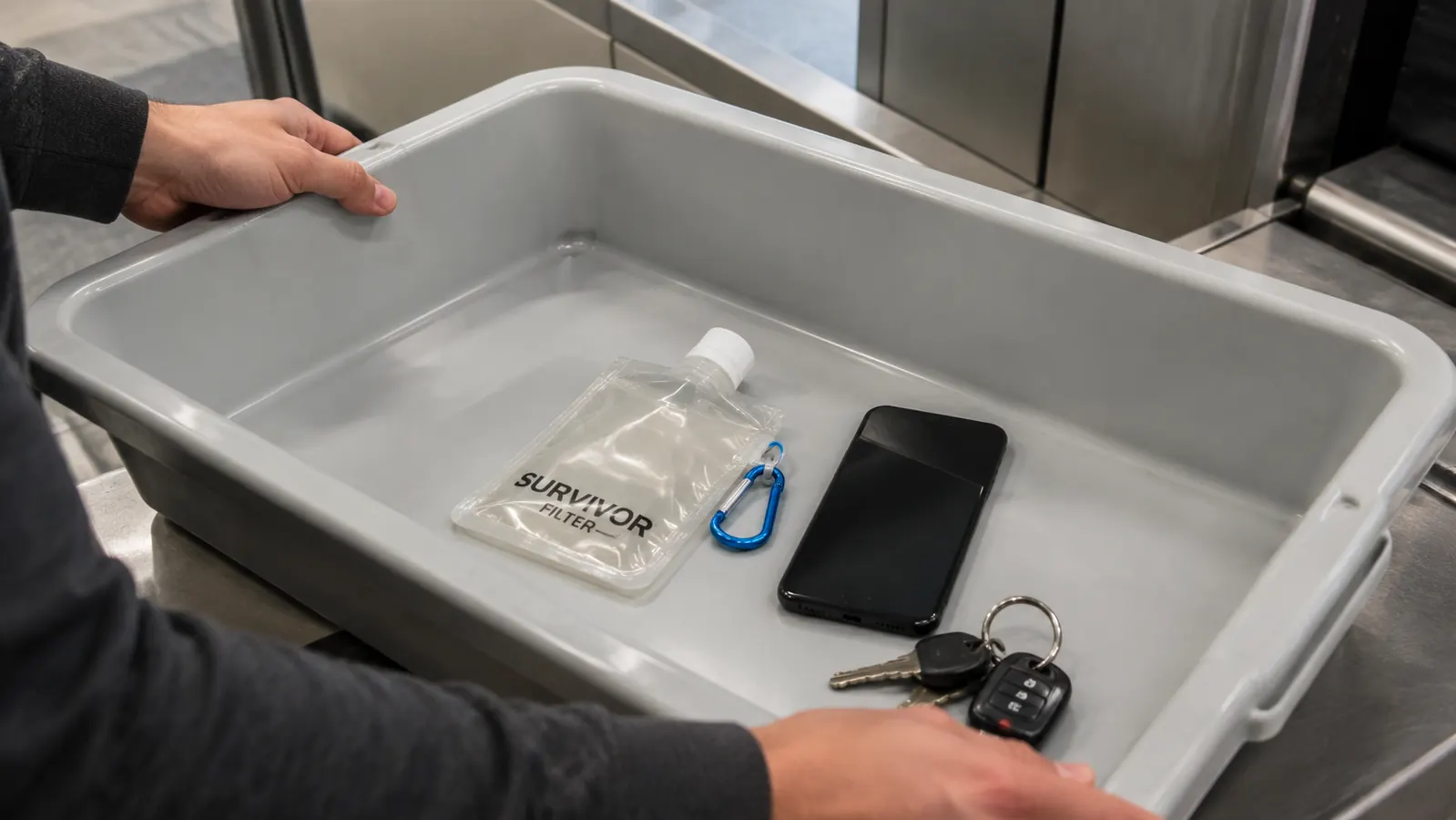
Step 2: Send it through the bin flat, not folded weird
When you get to the bin, lay the bottle flat rather than balling it up or leaving it half-collapsed. A weirdly bunched-up bottle sometimes reads oddly on the X-ray and gets flagged for a manual look, which is a five-minute delay you didn't need. Flat and empty, it looks like exactly what it is.
I keep mine in the same bin as my phone and belt rather than inside my backpack, mostly out of habit from an agent once asking me to remove it separately. It's a small thing but it saves the back-and-forth of them stopping the belt to ask you to pull it out.
If your bottle has a hard plastic cap or a metal carabiner clip, unclip it or set it loose in the bin too, since small hard attachments are exactly the kind of thing that triggers a second look on the scanner even when the bottle itself is a non-issue.
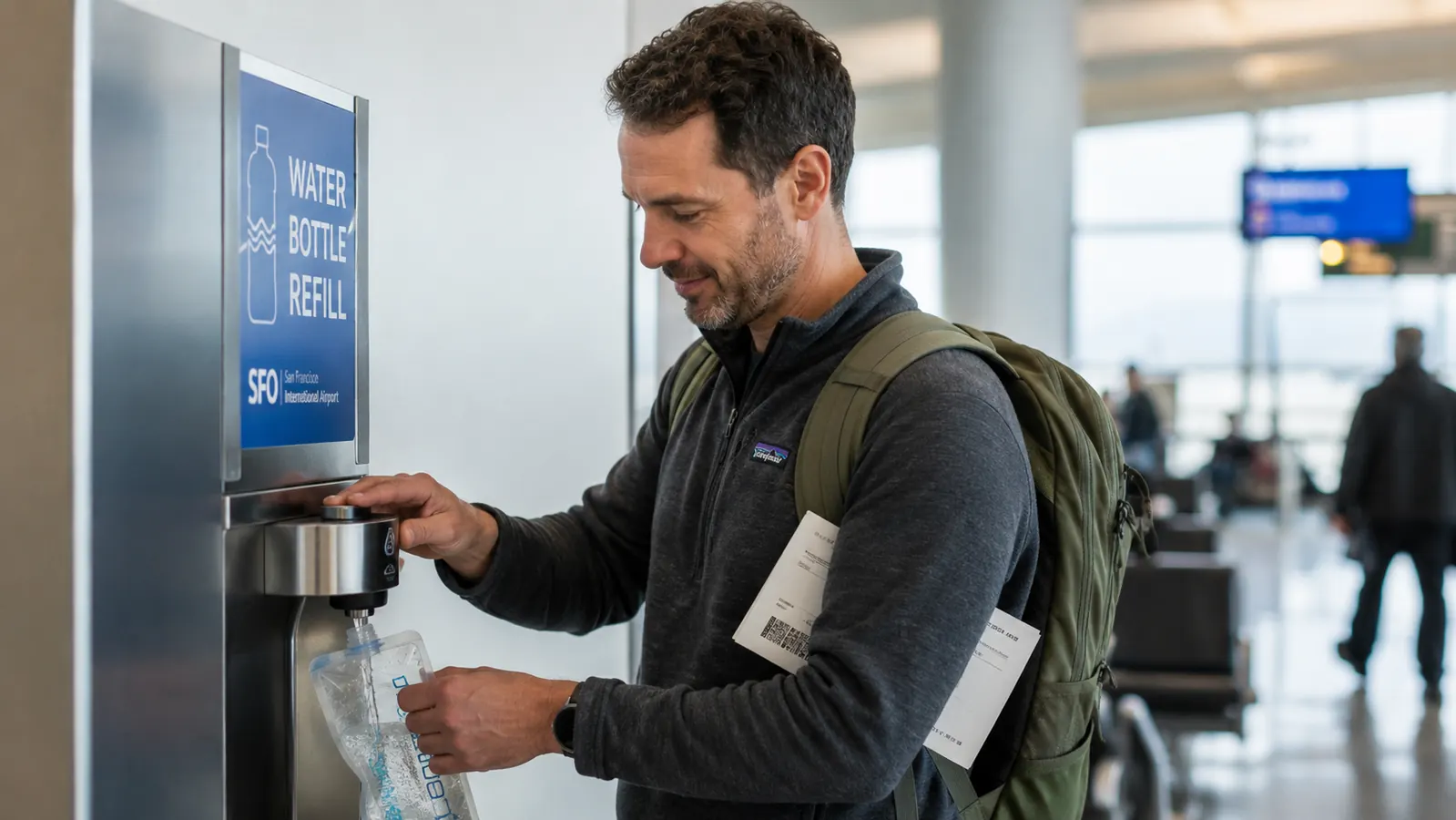
Step 3: Fill up at a real fountain, not a vending machine
Past security, most major airports now have bottle-filling stations built into the water fountains, the kind with a digital counter that tells you how many plastic bottles have been "saved" so far. Find one of these instead of a standard bubbler fountain. The flow rate is faster and the spout is shaped to actually get water into a bottle opening instead of spraying sideways.
I fill both bottles from the two-pack here if I'm traveling with my wife, since it takes maybe 20 extra seconds and means neither of us is asking a flight attendant for water twice an hour later. A 20-ounce collapsible bottle takes about 15 seconds to fill at a good station. If you can only find an old-style fountain, tilt the bottle at an angle rather than straight up under the spout, it fills faster and splashes less.
Smaller regional airports sometimes only have the old bubbler style near the gate, so I've gotten in the habit of checking an airport map app before I fly if I know I'll want a full bottle before a long flight. A minute of searching beats standing at a dribbling fountain trying to angle a bottle under a stream built for someone's mouth, not a bottle opening.
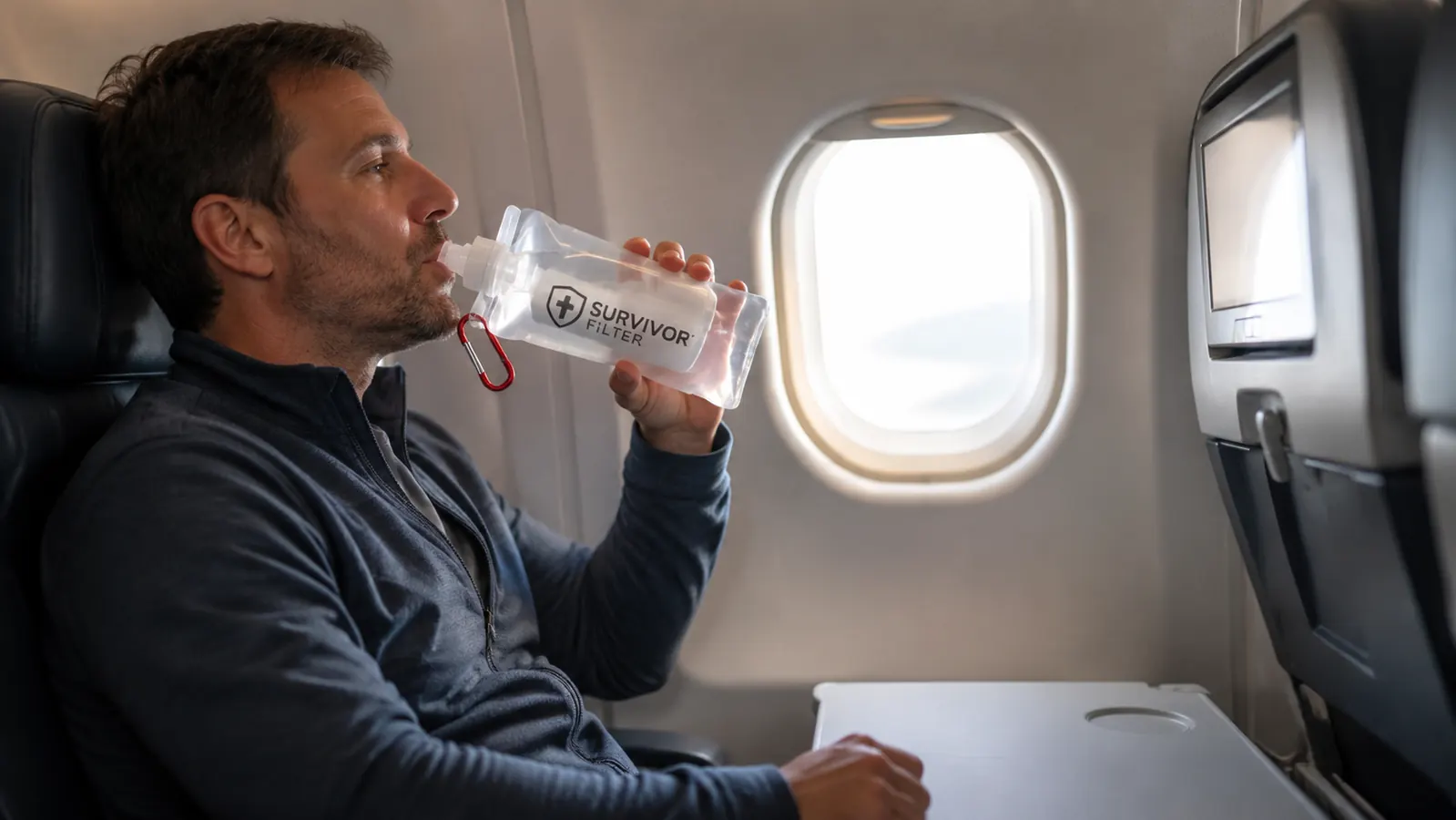
Step 4: Drink on a schedule, not when you notice you're thirsty
This is the step people skip, and it's the one that actually prevents the headache. Cabin dehydration sneaks up on you because the dryness doesn't feel like thirst in the usual way, it feels like tired eyes and a scratchy throat you blame on recycled air. By the time you notice you're thirsty, you're already behind.
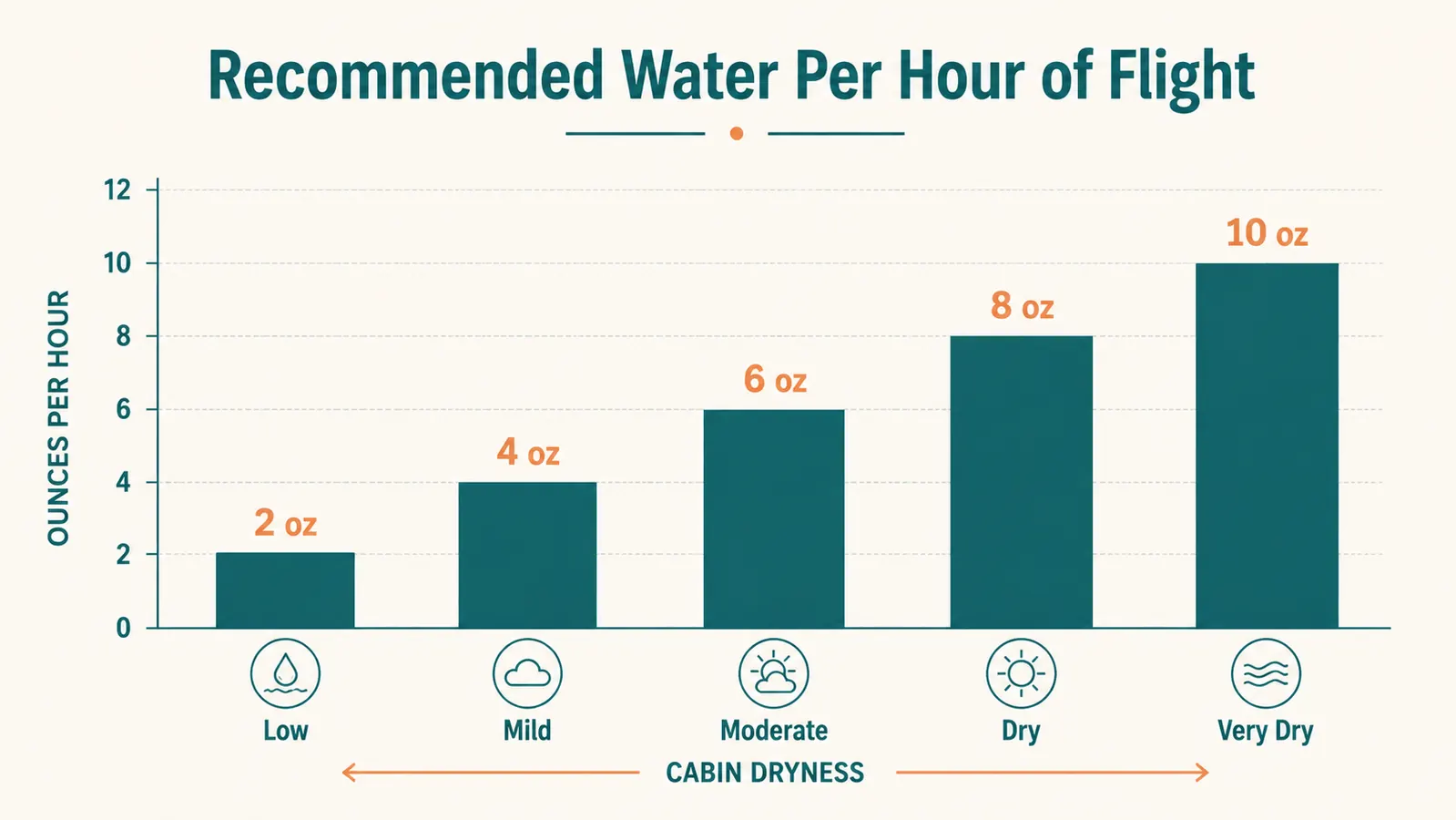
My rule of thumb is roughly 8 ounces per hour in the air, more if I had coffee or a drink at the gate, since both work against you. On a 5-hour flight that's a full bottle and most of a second fill. I set a phone reminder for the first flight or two until it becomes automatic, since the temptation is to nurse one bottle for the entire trip and call it good.
A soft, collapsible bottle actually helps here in a way I didn't expect. As it empties, it collapses down instead of sitting there half-full and awkward on the tray table, so you get a visual cue of how much you've actually had. A rigid bottle looks the same whether it's full or empty from across the cabin, a collapsible one visibly shrinks, which is a weirdly effective nudge to keep sipping.
On red-eyes I do this a little differently. I drink a full bottle before I try to sleep rather than sipping through the flight, since I'd rather deal with one bathroom trip mid-nap than wake up parched with two hours left in the air and nothing to do about it but wait for the drink cart.
Step 5: Refill again before landing if the option's there
On longer flights, flight attendants will usually top off a bottle if you ask nicely and hand it over during the beverage service, rather than making you use the tiny plastic cup. I do this once mid-flight and once about an hour before landing, since walking off the plane already hydrated makes a real difference in how you feel getting through customs or a rental car line an hour later.
If I'm connecting through a second airport, I let the bottle go mostly empty before the descent, fold it flat again once I'm off the plane, and repeat the whole routine at the fountain in the next terminal. The collapsible design earns its keep here too, since a half-full rigid bottle rattling around in a bag during a tight connection is just one more thing that can leak or get knocked over.
Landing dehydrated is the thing this whole routine is really built to prevent. It's an easy detail to overlook mid-flight, but a full bottle in hand when the wheels touch down means you're not starting a long layover or a drive from the rental counter already running on empty.
What Else Helps
A couple of small habits stack on top of the bottle routine. I skip or limit the free soda and alcohol on the flight, since both are mild diuretics and work against whatever water you're drinking. I also keep a stick of electrolyte powder in my bag for flights longer than six hours, since plain water alone doesn't always cut it after a red-eye. Neither of these replaces the bottle, they just make the water you do drink work harder.
I also try to get ahead of it the night before a long flight instead of starting the routine cold at the gate. A normal amount of water the evening before, rather than a scramble to chug a bottle in the terminal, means you're not trying to catch up on 12 hours of mild dehydration in the 40 minutes before boarding.
The bottle doesn't do the work. The schedule does. The bottle just makes the schedule possible without spending gate prices at the gate.
Why a Collapsible Bottle Specifically
You can run this same routine with a hard-sided bottle, and plenty of people do. Where the collapsible version pulls ahead for flying specifically is the packing math. A rigid 24-ounce bottle takes up the same amount of space whether it's full, empty, or somewhere in between, and that's dead space in a carry-on for the outbound leg of a trip when you haven't filled it yet. A collapsible bottle folds down to roughly the thickness of a phone case when empty, so it costs you almost nothing to bring along on the way there.
The tradeoff, and I'll be straight about it, is that a soft-sided bottle doesn't keep water cold the way an insulated steel one does, and the material has a slight plastic taste for the first few fills until it breaks in. If ice-cold water on a hot hike is the priority, a hard insulated bottle wins. If the priority is getting through security fast and not wasting bag space on the way out, the collapsible design is built for exactly that trip.
The two-pack format matters more than it sounds like it should, too. On a trip with a travel partner, having a second bottle folded flat in the same bag costs nothing extra to pack, but it means you're not sharing one bottle back and forth through a five-hour flight, which is a small annoyance that adds up over a long trip.
Build the routine around a bottle that actually folds flat for security.
The Survivor Filter Clear Collapsible Water Bottle two-pack means you and a travel partner both skip the gate water markup, on every leg of every trip.
Amazon Check Today's Price on Amazon →